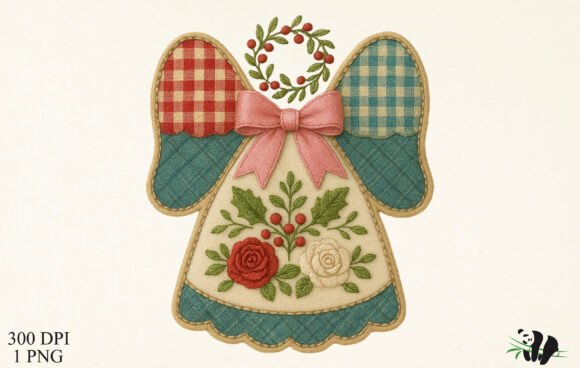
Faux Embroidery Patchwork Angel Wings
First Impression: Whimsical, Textural, and Booth-Ready
As an embroidery designer who’s set up at over 70 craft fairs—from snowy winter markets to sun-drenched summer pop-ups—I know what stops a shopper mid-aisle. Faux Embroidery Patchwork Angel Wings delivers that instant visual pause. It doesn’t scream “trendy” or “minimalist”—it whispers “handmade magic.” The title alone suggests layered texture, soft contrast, and intentional imperfection—exactly the kind of warmth customers reach for when browsing handmade goods. It reads as gentle but confident: not overly sweet, not gothic, not cartoonish—just quietly evocative. That balance makes it ideal for makers who sell with heart, not hype.
Where It Shines: Product-by-Product Reality Check
This design thrives where tactile charm meets everyday function. On tote bag designs, it anchors the front panel beautifully—large enough to read from three feet away, detailed enough to invite closer inspection. As apron embroidery, placed just above the pocket or centered on the bib, it adds soul without overwhelming utility. For tea towel embroidery, its patchwork suggestion plays perfectly against linen or cotton waffle weave—especially when stitched in tonal ecru, charcoal, and oat thread colors.
Embroidered patches are where Faux Embroidery Patchwork Angel Wings truly earns its keep. Cut, fused, or sewn onto denim jackets, canvas pouches, or pillow covers, it reads as heirloom-quality—even though it’s digitally designed. On caps, I’d recommend using it as a small back-strap accent (not crown placement) to avoid distortion on curved surfaces. And for handmade gifts like mini pouches or market bags? It transforms simple cotton into something giftable, memorable, and Instagram-ready.
Photography & Online Appeal: Why Your Etsy Seller Page Will Thank You
The included digital embroidery file is a 4000×4000 pixel, 300 DPI PNG with transparent background—ideal for clean printable mockups. That resolution means crisp shadows, accurate thread color simulation, and zero pixelation in Etsy listings or Instagram carousels. Because it’s solid-color RGB (not vector), it holds up well across fabric swatches in your shop photos—no worrying about gradient bleed or anti-aliasing blur. When paired with natural lighting and neutral backdrops, Faux Embroidery Patchwork Angel Wings looks intentionally crafted—not mass-produced. That perception lifts perceived value instantly.
Production Practicality: Batch-Friendly, But Not Blindly So
This isn’t a “drop-and-stitch” design—but it’s not a nightmare either. Its structure supports efficient batch production if you plan ahead. It works cleanly as both a small accent (2.5" wide on a patch) and a large focal design (6.5" tall on a tote). However—here’s the real talk—its faux-patchwork aesthetic relies on clear separation between “fabric” sections. That means stitch density matters. Areas meant to read as distinct fabric pieces need sufficient spacing between satin columns or fill motifs. If packed too tightly, the illusion collapses into muddy texture.
Careful-Use Notes Every Embroidery Designer Should Flag
- Dense stitch areas: Watch fill zones between wing layers—they can pucker on lightweight cotton unless stabilized properly.
- Tiny details: Avoid scaling below 2" wide; fine inner lines may vanish on textured towels or thick canvas.
- Dark fabric: Test thread contrast early. Cream or light gray thread pops on navy or charcoal—but vanishes on black without metallic or high-sheen alternatives.
- Curved cap surfaces: Not recommended for front panels. Use only on flat rear straps or side panels with low-profile underlay.
- Fabric texture: Waffle-weave tea towels and looped terry require medium-cutaway stabilizer + reduced top tension to prevent sinking.
Booth Impact & Buyer Engagement: More Than Just a Design
In person, Faux Embroidery Patchwork Angel Wings builds emotional connection fast. It’s recognizable at 10 feet, intriguing at 3 feet, and satisfyingly detailed at arm’s length—perfect for craft fair pacing. Customers don’t just see wings; they see care, story, and intention. That translates directly to dwell time, questions (“Did you stitch all these layers?”), and yes—sales. Pair it with complementary items (e.g., matching embroidered tea towels + angel-wing pouches), and it strengthens your brand consistency across categories. It also invites customization: swap thread palettes for seasonal booths (rose gold for weddings, sage + cream for spring markets).
Designer-to-Designer Must-Dos Before Cutting Fabric
- Test on scrap fabric—same weight and finish as your final product.
- Check thread contrast across at least three fabric colors (light, medium, dark).
- Review spacing between implied “patches”—ensure gaps remain legible after stitching.
- Confirm hoop size compatibility before digitizing or purchasing a commercial embroidery file.
- Inspect stitch density in layered zones—adjust underlay or reduce fill angle if needed.
- Use the right stabilizer: cutaway for knits, tear-away for stable wovens, medium for textured towels.
- Create at least one real mockup—not just digital. Lighting, drape, and hand-feel change everything.
- Compare fabric colors side-by-side—dyes shift under booth lighting.
- Confirm commercial licensing before selling finished products. This listing says “PNG Files”—verify usage rights with the seller.
Final Thought: A Quiet Standout in a Loud Market
Faux Embroidery Patchwork Angel Wings won’t dominate your booth like a neon slogan—but it will linger in memory like a favorite handmade gift. It’s the kind of craft fair product that sells because it feels earned, not engineered. For Etsy sellers, small shop owners, and boutique makers building a cohesive line of handmade products, it’s less a graphic and more a signature gesture. Paired with thoughtful execution—stabilizer choice, thread selection, and real-world testing—it becomes more than decoration. It becomes trust. And in handmade markets, trust is the first stitch in every sale.