Tulip Flower Embroidery Design File
A Seasonal Designer’s First Impression
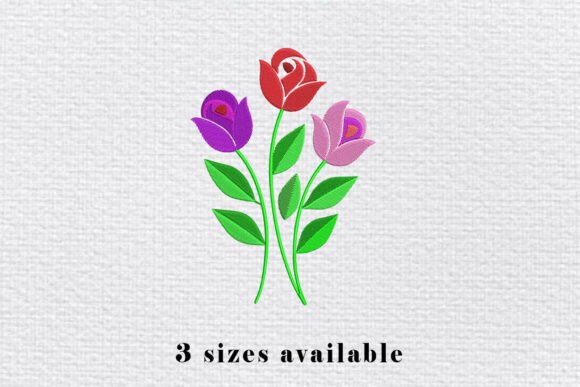
As an embroidery designer who builds collections around holidays, gifting rhythms, and emotional resonance, the Tulip Flower Embroidery Design File landed with quiet confidence—not flash, but intention. Three blooming tulips in red, pink, and purple evoke spring awakening, gentle romance, and quiet celebration. It’s not loud or kitschy; it’s elegant, delicate, and quietly festive. This isn’t a design shouting “Easter!” or “Mother’s Day!”—it’s the kind that whispers “thoughtful,” “handmade,” and “cherished.” The single-flower composition fits perfectly within the Single Flowers category while offering surprising versatility across seasons: early spring launches, Easter gift bundles, Mother’s Day aprons, bridal shower kitchen towels, and even subtle Valentine’s Day pillow covers.
How It Performs in Real Holiday Selling Situations
In my shop planning for Q1–Q2 holiday drops, the Tulip Flower Embroidery Design File shines where emotional connection meets practicality. On sweatshirt embroidery, it reads beautifully at 3.5–4 inches wide—large enough to anchor a chest placement but refined enough to avoid overwhelming cozy fabric. As a tote bag design, it elevates everyday utility into a handmade gift—especially when paired with linen or canvas and soft thread colors. For kitchen towel embroidery, its clean petal outlines stitch crisply on terry cloth with proper cutaway stabilizer, and the three-color variation invites subtle tonal play (think dusty rose + charcoal gray thread on ivory cotton).
This machine embroidery design also works exceptionally well in gift bundles: imagine a set of embroidered baby onesies, a matching burp cloth, and a mini embroidered patch—all using the same embroidery file scaled down thoughtfully. On Etsy, listings featuring this digital embroidery file gain traction when paired with realistic printable mockups showing it on pillow covers, ceramic ornaments, and linen napkins. At craft fairs, customers consistently pause at displays where the Tulip Flower Embroidery Design File appears on natural-fiber aprons and organic-cotton tea towels—it signals care, craftsmanship, and seasonal authenticity.
Where to Use It With Intention (Not Assumption)
Even elegant designs have limits—and knowing them prevents costly rework. The Tulip Flower Embroidery Design File includes fine petal edges and layered color transitions, so stitch density matters. Avoid cramming it into under-3-inch hoops without verifying detail retention—petal tips can blur or feather on dense fabrics. On thick kitchen towel embroidery or textured linen, always test with your exact stabilizer combo: medium-weight cutaway is ideal; tear-away may shift under dense satin stitching.
For dark fabric, use bright white or ecru bobbin thread and consider slightly heavier top thread (like 40-weight rayon) to maintain vibrancy. On stretchy garments like ribbed knit tees, add lightweight fusible stabilizer behind the hoop—not just tear-away—to prevent puckering around curved tulip stems. And while it’s lovely on curved caps, skip it unless you’ve confirmed the hoop size and digitizing allows smooth registration on convex surfaces. Lastly, if you’re planning commercial embroidery for resale, verify licensing upfront—this embroidery file must be cleared for finished product use before launching limited-edition apparel or personalized gifts.
Design Notes Every Seasonal Seller Should Keep Handy
- Test thread colors on both light and dark fabric—the red/pink/purple palette shifts dramatically depending on base tone and lighting.
- Check stitch density before scaling down: fine details compress quickly below 2.75 inches.
- Confirm hoop size compatibility with your machine and intended product—e.g., 4x4” works for most tote bags; 5x7” gives breathing room for pillow covers.
- Use proper stabilizer matched to fabric texture—not just weight, but drape and absorbency.
- Create realistic mockups before listing: show how the Tulip Flower Embroidery Design File looks on actual sweatshirt seams, towel hems, and apron pockets.
- Review small details after stitching: petal edges, stem taper, and color transitions should hold clarity—even after laundering.
- Plan matching color palettes across products: coordinate thread hues with packaging, tags, and social media visuals to strengthen brand consistency.
- Confirm commercial licensing before selling finished seasonal products—especially for holiday drops with tight timelines.
Why This Design Builds Trust and Drives Holiday Sales
The Tulip Flower Embroidery Design File doesn’t just decorate—it communicates value. In a crowded holiday marketplace, shoppers scan for authenticity and intention. A well-executed tulip says “I chose this,” not “I mass-produced it.” That perception lifts perceived product value, increases average order value in gift bundles, and encourages repeat purchases from customers who recognize your signature floral style. Its timeless appeal means it won’t feel dated by January—it transitions smoothly from Easter to spring weddings to early summer garden parties.
For the Etsy seller, the Tulip Flower Embroidery Design File supports strong visual recognition: consistent use across pillow cover, embroidered patch, and apron listings builds a cohesive shop aesthetic. For the small shop product creator, it offers flexibility—scale it up for table linens, scale it down for baby onesies, rotate colors for gender-neutral gifting. And because it avoids trend-chasing clichés, customers trust it as a personalized gift that feels meaningful—not generic.
In short: this seasonal embroidery piece earns its place not because it’s flashy, but because it’s thoughtful, adaptable, and emotionally resonant. When you pair it with intentional fabric choices, smart stabilization, and authentic storytelling, the Tulip Flower Embroidery Design File becomes more than decoration—it becomes part of your seasonal story.