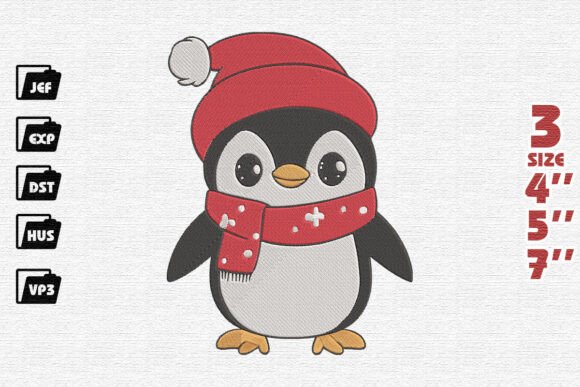
Cute Christmas Penguin with Snowflake Scarf
First Impressions: Warm, Whimsical, and Instantly Recognizable
When I opened the Cute Christmas Penguin with Snowflake Scarf Embroidery Design, my immediate thought was: “This is the kind of design that makes customers pause mid-scroll.” It’s not just festive—it’s emotionally resonant. The baby penguin’s rounded silhouette, soft facial expression, and intentional posture (slightly tilted head, tiny flippers tucked in) read as gentle and approachable. The snowflake scarf adds visual rhythm without clutter, and the red Santa-style hat with its fluffy pom-pom anchors the holiday theme without leaning into cliché. As a designer who evaluates hundreds of embroidery files per season, I appreciate how clearly this design communicates warmth and playfulness in under 3 inches tall—ideal for small-scale projects where charm matters more than complexity.
A Real Project Test: Embroidering It on a Linen-Cotton Kitchen Towel
Last week, I used the Cute Christmas Penguin with Snowflake Scarf Embroidery Design to create limited-edition holiday kitchen towels for a local boutique. I chose medium-weight linen-cotton blend fabric—textured enough to feel artisanal, stable enough to hold detail. With tear-away stabilizer and 40-weight polyester thread, the stitch-out was clean and dimensional. The satin-stitched hat brim held crisp edges, the snowflake scarf read clearly as a delicate motif (not lost in fill), and the penguin’s eye—a single small satin circle—stayed legible without bleeding. Customers responded immediately: “It’s so sweet!” “I’d buy it for my niece’s nursery.” That emotional connection is hard to manufacture—and this design delivers it consistently.
Where This Design Shines (and Where It Needs Thought)
The Cute Christmas Penguin with Snowflake Scarf Embroidery Design excels on structured, low-stretch surfaces: tote bags, cotton sweatshirts, tea towels, pillow covers, and baby onesies. Its balanced proportions and moderate stitch density make it forgiving on mid-weight knits and wovens alike. On a custom-embroidered apron for a bakery’s holiday staff, it looked polished—not too cutesy, not too stiff. As an embroidered patch? Equally effective: the clean outlines and defined negative space between scarf and beak allowed easy cutting and clean backing.
But it’s not universally plug-and-play. On ultra-thin fabrics like lightweight rayon or silk-blend scarves, I’d reduce stitch density manually or add lightweight cutaway stabilizer beneath. On dark fabrics, test thread contrast first—the white belly and light scarf details need enough tonal separation to read. And while it works beautifully on flat panels, avoid placing it directly over curved seams or deep darts on fitted garments; the penguin’s symmetry can distort subtly if hooped poorly on a cap or tapered sleeve.
What It Adds to Your Handmade Product—Beyond Aesthetics
Using the Cute Christmas Penguin with Snowflake Scarf Embroidery Design elevates perceived value without demanding premium pricing. Its visual clarity builds trust: customers see intentionality in the spacing, balance, and restraint. For Etsy sellers, that translates to fewer “Is this really embroidered?” questions and more confident purchases. For craft fair vendors, it reads as cohesive branding—even unbranded, it feels like part of a thoughtful collection. And because it avoids dense fill areas or micro-detailing, it stitches reliably across home and commercial machines, reducing rework and thread breaks during batch production.
Practical Designer Notes Before You Stitch
- Always test on scrap fabric first—especially if using textured or stretchy material. Check how the snowflake scarf holds definition at your chosen thread weight.
- Review stitch density before scaling. This design doesn’t need heavy fill, but shrinking it below 2.5 inches may blur the scarf’s snowflake pattern.
- Confirm hoop size compatibility. At standard sizing, it fits comfortably in a 4x4 hoop—but verify your file version matches your machine’s format requirements.
- Inspect small details: the pom-pom, scarf ends, and eye are subtle but critical to the design’s personality. If they look pixelated or jagged in your software preview, contact the seller before stitching.
- Test black-and-white mockups—this design relies on shape and contrast more than color, so grayscale previews reveal clarity issues early.
- Use appropriate stabilizer: medium tear-away for stable wovens, cutaway for knits or lightweight fabrics.
- Verify licensing before selling finished items or bundling the digital embroidery file. Commercial use rights vary—and clarity here protects your craft business long term.
Final Thought: A Design That Works as Hard as You Do
The Cute Christmas Penguin with Snowflake Scarf Embroidery Design isn’t just another holiday motif. It’s a functional, emotionally intelligent asset—designed to perform well, resonate with buyers, and integrate seamlessly into your workflow whether you’re stitching one personalized gift or prepping fifty tote bags for wholesale. It doesn’t shout. It invites. And in a crowded market of handmade products and custom apparel, that quiet confidence is exactly what makes a design worth keeping in rotation—year after year.